
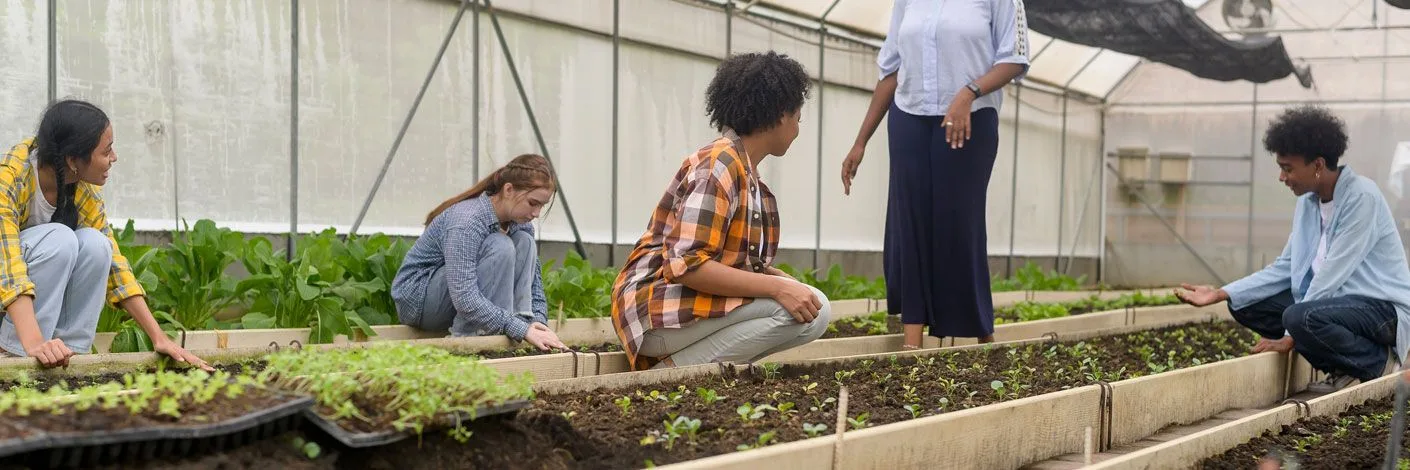
Secondary School Program
The VEG Education Farm Gate Program for Secondary Schools provides an immersive, professionally oriented exploration of modern horticulture and the fresh produce sector. Through a combination of farm visits, hands-on workshops, and specialised learning resources, the program connects classroom theory with real-world agricultural practices. Students investigate how vegetables are produced at scale, the technologies driving industry innovation, and the complex social, economic, and environmental factors that influence Australia’s food system.
Designed to support STEM learning, Design and Technologies, Geography, and VET pathways, the program encourages students to think critically about sustainability, food waste, food citizenship, and food sovereignty, while also highlighting diverse career opportunities across horticulture and the broader food supply chain.
Topics Covered
1. Modern Horticultural Systems
2. Agricultural Technologies & Innovation
3. Sustainability & Environmental Stewardship
4. Food Waste & Circular Economy
5. Food Citizenship & Food Sovereignty
6. Careers in Horticulture & the Food System
7. Farm Visit & Applied Learning Workshops
By participating in the program, secondary school students will:
Knowledge & Understanding
- Explain how vegetables are grown, processed, and delivered within complex supply chains
- Understand modern agricultural technologies and their role in sustainable food production
- Analyse factors influencing food waste, environmental impact, and resource use
- Demonstrate understanding of food citizenship and food sovereignty concepts
- Recognise the breadth of careers available within the horticulture and fresh produce industries
Skills Development
- Apply scientific inquiry and data interpretation to real farm environments
- Use design thinking to solve agricultural challenges (e.g., productivity, sustainability, waste reduction)
- Evaluate the environmental, social, and economic impacts of agricultural decisions
- Communicate findings through reports, presentations, or practical demonstrations
- Engage with industry professionals and understand workplace expectations
Values & Attitudes
- Develop informed perspectives on sustainable and ethical food systems
- Build appreciation for the work, skills, and innovation required to produce fresh food
- Strengthen interest in VET pathways and STEM-related agricultural careers
- Foster responsibility and agency as consumers and participants in the food system
Curriculum Alignment
The program aligns strongly with the Australian Curriculum, senior secondary subject frameworks, and VET pathways, including:
Design and Technologies (Years 7–10)
- Food and Fibre Production (ACTDEK032)
- Investigating contemporary food and fibre systems
- Processes and Production Skills (ACTDEP035–ACTDEP049)
- Designing, testing, and evaluating sustainable solutions
Science (Years 7–10)
- Biological Sciences: ecosystems, nutrient cycles, plant physiology
- Earth & Environmental Science: resource management, climate impacts
- Science Inquiry Skills: fieldwork, data collection, analysis, evaluation
Geography (Years 7–10)
- Environmental Change & Management
- Place, Space, and Interconnectedness
- Global Food Systems & Food Security (ACHGK075–ACHGK080)
Health & Physical Education
- Food and nutrition — access, equity, sustainable diets
Ethical Understanding / Civics & Citizenship
- Ethical food choices, sustainability, social responsibility
- Food citizenship and sovereignty concepts
Senior Secondary & VET Pathways
Supports alignment with:
- VET Agriculture / Horticulture (AHC)
- Food & Fibre Industry Skills
- STEM pathways
- Environmental Science & Geography
Work Studies (Years 9–10)
Career exploration, workplace learning
